
















This glossary covers every metric available in Commerce Intelligence (CI), explains how each is calculated, and shows how it compares to its Shopify equivalent.
CI's approach to metrics
CI uses a unit economics waterfall — a clean, top-to-bottom model that starts with what the customer paid and removes everything the merchant doesn't keep:
Sales → minus Shipping Revenue → minus Taxes & Duties → minus Refunded Value = Net Revenue
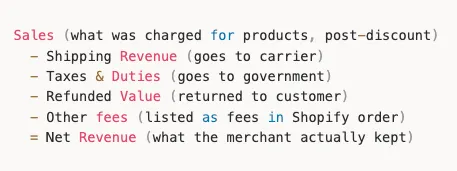
Every line is real money moving in one direction. There is no step where the number goes back up. There is no theoretical "you could have earned this" figure.
Core metrics
Orders
- Definition: Number of non-cancelled orders placed
- Formula: Count of orders where status is not "cancelled"
- Available on: Markets
- Shopify equivalent: Orders (but Shopify includes cancelled, pending, and unpaid orders by default)
- How to reconcile: CI Orders = Shopify Orders minus cancelled orders minus POS/pickup orders and Swap Gift Card orders (SGC-orders created by Swap Returns)
- Note: Only orders with a shipping address at order creation are included. POS orders and pickup-in-store orders are excluded because they have no delivery destination.
Sales (Markets analytics)
- Definition: Post-discount order subtotal. What customers paid for products, before taxes, shipping, and returns. This value reflects the original order at the time of placement and does not change if the order is later edited.
- Formula: Sum of order value after discount application, excluding cancelled orders
- Shopify equivalent: No direct equivalent. Closest is Shopify Gross Sales minus Discounts. Shopify updates values after order edits and returns; CI preserves the original values and tracks returns separately.
- How to reconcile: CI Sales should closely match Shopify Gross Sales - Shopify Discounts for non-cancelled, non-edited orders. Differences arise from order edits (CI preserves originals, Shopify reflects current state) and returns (CI tracks them separately).
Sales (Products analytics)
- Definition: Post-discount order subtotal. What customers paid for products, before taxes, shipping, and returns. This value reflects the original order at the time of placement and does not change if the order is later edited.
- Formula: Sum of (product price x quantity) after discount application, excluding cancelled orders
- Shopify equivalent: No direct equivalent. Closest is Shopify Gross Sales minus Discounts. Shopify updates values after order edits and returns; CI preserves the original values and tracks returns separately.
- How to reconcile: CI Sales should closely match Shopify Gross Sales - Shopify Discounts for non-cancelled, non-edited orders. Differences arise from order edits (CI preserves originals, Shopify reflects current state) and returns (CI tracks them separately).
AOV
- Definition: Average order value — average revenue per order
- Formula: Sales / Orders
- Available on: Markets
- Shopify equivalent: Shopify AOV = (Gross Sales - Discounts) / Orders
- How to reconcile: Should closely match for non-cancelled, non-edited orders. Differences arise when orders are edited after placement (CI preserves originals, Shopify reflects current state).
AVG Sale Price
- Definition: Average selling price per unit
- Formula: Sales / Units Ordered
- Available on: Products
- Shopify equivalent: No standard equivalent (derivable from Shopify data)
Units Ordered
- Definition: Total quantity of product units in the order at the time of placement. This value does not change if items are later added to or removed from the order.
- Available on: Markets, Products
- Shopify equivalent: Quantity Ordered. Shopify updates after order edits and returns; CI preserves the original quantity and tracks returns separately.
- How to reconcile: Differences arise from order edits (CI preserves originals, Shopify reflects current state) and returns (CI tracks these separately rather than deducting from the quantity).
Global Units Ordered
- Definition: Units ordered through Swap Global. A subset of Units Ordered.
- Available on: Products
- Shopify equivalent: No equivalent (Shopify does not distinguish by fulfilment channel in standard reports)
Global Sales
- Definition: Revenue from orders fulfilled through Swap Global. A subset of Sales.
- Available on: Products
- Shopify equivalent: No equivalent
Global Order Count
- Definition: Number of Swap Global orders. On the Markets page this is the total count per market. On the Products page this is the number of Swap Global orders containing a given product or variant.
- Available on: Markets, Products
- Shopify equivalent: No equivalent
Unique Orders
- Definition: Number of distinct orders containing a given product or variant
- Available on: Products
- Shopify equivalent: No standard equivalent (derivable from Shopify data)
Shipping Revenue
- Definition: Shipping amount charged to the customer at the time of order placement. This value does not change if the order is later edited.
- Available on: Markets
- Shopify equivalent: Shopify Shipping (net of discounts and refunds)
- How to reconcile: Differences arise from order edits (CI preserves originals, Shopify reflects current state) and shipping refunds (Shopify deducts them, CI does not).
- Note: Shipping Revenue is what the customer was charged for shipping, not the merchant's actual shipping cost. CI currently uses customer-facing Shipping Revenue as a proxy for shipping cost in the Net Revenue calculation.
Taxes & Duties
- Definition: Taxes and import duties charged on the order at the time of placement. This value does not change if the order is later edited.
- Available on: Markets, Products (for Products — only in case of Swap Global orders)
- Shopify equivalent: Shopify Taxes & Duties (net of refunds)
- How to reconcile: Differences arise from order edits (CI preserves originals, Shopify reflects current state) and tax/duty refunds (Shopify deducts them, CI does not).
Units Returned
- Definition: Number of product units returned through Swap
- Available on: Markets, Products
- Shopify equivalent: Returned Item Quantity (but Shopify includes returns from all processors)
- How to reconcile: CI only includes Swap-processed returns. Shopify includes all returns.
- Note: Only counts returns processed through Swap.
Return Rate
- Definition: The percentage of ordered units that were returned
- Formula: Units Returned / Units Ordered
- Available on: Markets, Products
- Shopify equivalent: Not a standard Shopify metric (derivable from Shopify data)
- Note: Only counts returns processed through Swap.
Refunded Value
- Definition: Total monetary value of goods returned through Swap
- Available on: Markets
- Shopify equivalent: Returns / Sales Reversals (covers all returns regardless of return processor)
- How to reconcile: CI only includes Swap-processed returns. Shopify includes all returns. They match when all returns go through Swap.
Net Revenue
- Definition: What the merchant actually kept from the order after all deductions
- Formula: Sales - Shipping Revenue - Taxes & Duties - Refunded Value - Other fees reflected in Shopify
- Available on: Markets
- Shopify equivalent: No direct equivalent. Shopify's "Net Sales" is a different calculation (Gross Sales - Discounts - Returns, before tax/shipping).
Discount Penetration
- Definition: Percentage of orders that had a discount applied
- Available on: Products
- Shopify equivalent: No standard equivalent
Total Fees
- Definition: Total Swap fees charged for the market
- Available on: Markets
- Shopify equivalent: No equivalent
Key principles to remember
CI preserves original order values
CI records order values at the time of placement and does not update them if the order is later edited. If items are added, removed, or prices change after the order is placed, CI still shows the original values. The only exception is cancellation — cancelled orders are removed from all metrics entirely.
This is the most common reason you'll see different numbers in CI vs Shopify:
- CI: Shows the original order values as they were when placed. Returns are tracked separately as a Refunded Value metric and deducted in the Net Revenue calculation, but the underlying Sales, Shipping Revenue, and Taxes & Duties figures remain unchanged.
- Shopify: Updates order values after edits and returns, so figures reflect the current net state of the order.
Returns are attributed to order date
A January order returned in February appears in January's data in CI (but February's in Shopify). CI's approach shows you the complete economics of orders placed in each period.
Only Swap-processed returns are included
If you use multiple return processors, CI will only show returns handled by Swap. This means CI's return figures may be lower than Shopify's.
Cancelled orders are excluded
CI does not count cancelled orders in any metric. This avoids inflating order counts and revenue with transactions that never completed.
POS and pickup-in-store orders are excluded
CI only includes orders that have a shipping address at the time of order creation. Orders without a delivery destination — such as Point of Sale (POS) transactions and pickup-in-store orders — are excluded from all metrics. Without a shipping address, these orders cannot be grouped by country, market, or region, and would otherwise appear as "undefined" entries. If you process in-store or pickup orders, CI's totals will be lower than Shopify's.
Quick reference
Metric | Available on | What it measures |
Orders | Markets | Non-cancelled order count |
Sales | Markets, Products | Post-discount revenue |
AOV | Markets | Average revenue per order |
AVG Sale Price | Products | Average selling price per unit |
Units Ordered | Markets, Products | Quantity of units ordered |
Global Units Ordered | Products | Units ordered in Swap Global orders |
Global Sales | Products | Revenue from Swap Global orders |
Global Order Count | Markets, Products | Swap Global order count |
Unique Orders | Products | Distinct orders per product |
Shipping Revenue | Markets | Shipping charged to customer |
Taxes & Duties | Markets, Products | Taxes and duties charged |
Units Returned | Markets, Products | Units returned through Swap |
Return Rate | Markets, Products | Units returned / units ordered |
Refunded Value | Markets | Monetary value of Swap returns |
Net Revenue | Markets | Sales minus all deductions |
Discount Penetration | Products | Percentage of discounted orders |
Total Fees | Markets | Swap fees charged |